

Is UX design a jaded profession?
Is it time to go?

Here’s the fact: the market now values immediate output over strategic headcounts.
I have been in the UX industry or profession for close to 20 years. I started without knowing or realising that this would be a profession or path that I carry on until now. I cannot imagine doing anything else right now.
I was super motivated until maybe like 2023. That was the height of my career, and I think that coincided with two important milestones in the industry: the advent of AI and also the waves of layoffs from big tech a.k.a tech winter.
Many tech workers, including designers, product managers and engineers alike feel the crunch and many of them take sabbaticals. This is something unimaginable before. Who dared to take a year off from their CV? What would recruiters and hiring manager think?
I lost my job twice in 2025. One due to a layoff, the other one due to a mismatch in expectation. I think that set further precedence to my heavy burnout in the industry. I left Singapore in January 2026, despite being a permanent resident, to mainly pursue a break. But 2026 is a different year. It is better in a sense that more opportunities start pouring in. However, I wanted to be intentional in where I go. But still, it hasn’t felt like back in the days of the heydays — everything feels just like another job. Maybe a few sounds and feels prospectively better, most don’t.
I also don’t know where I should take my career trajectory: leadership or individual contributor. Even so, in what level. My highest position was a Senior Manager, Product Design at Tripadvisor. That leveling did not obviously guarantee anything similar after. Every company gauges leveling very differently. Right now I settle into a senior product designer role, something I last had in 2020. Like most people, I guess it’s fine, rather than not having any job, or having a job you dislike? My priority is doing good work, stay close to the family, and be sane.
Burnout on the rise
Reading the state of the industry, one cannot avoid the fact that burnout is on th rise:
Burnout is surging, and optimism is fading. Significant burnout rose from 44.7% to 55.7% of respondents, while career optimism fell from 54.8% to 48.7%. Those who feel destabilized by AI are feeling the least optimistic and the most burned out. A worrisome trend.
The Nielsen Norman Group officially dubbed this era The UX Reckoning, noting that across the industry, “pessimism, disillusionment, and frustration are widespread” as corporate budgets tighten and design is pushed back to the chopping block. For two decades, UX enjoyed hyper-growth, but the convergence of tech layoffs, interest rate shifts, and generative AI has stripped away much of the craft’s perceived strategic influence. Exhaustion is rampant among veterans who feel that true user advocacy has been replaced by metric-chasing, feature bloat, and endless stakeholder management. As one 11-year design veteran wrote in a candid farewell on Reddit’s r/UXDesign:
“Only about 10–20% of my time is spent actually designing. The rest is presenting decks... facilitating alignment, evangelising concepts... A lot of the work is tedious and not fulfilling... I just feel devalued.”
At the same time, the hiring market has aggressively recalibrated away from creative ambition toward risk mitigation and title deflation. A recent market breakdown on UX Planet highlights that companies no longer ask if a designer is talented, but whether they are a “risk,” adding that “skill is no longer the differentiator. Reliability is”. This shift has forced senior leaders into lower-level IC roles just to secure employment, while normalising previously unthinkable choices like multi-month sabbaticals or walking away from tech altogether. With AI eating away at routine execution and organisations demanding immediate ROI over thoughtful process, many designers are realising that the emotional tax of modern tech culture no longer yields the personal fulfilment it once did.
The Gal Shir shock
Gal Shir, renowned illustrator and brand designer, shared his shocking (well maybe not so much by a mile) tweet a couple of weeks ago. Here’s the tweet. I screenshot it for posterity, so that whenever he takes it down we have a documentation.
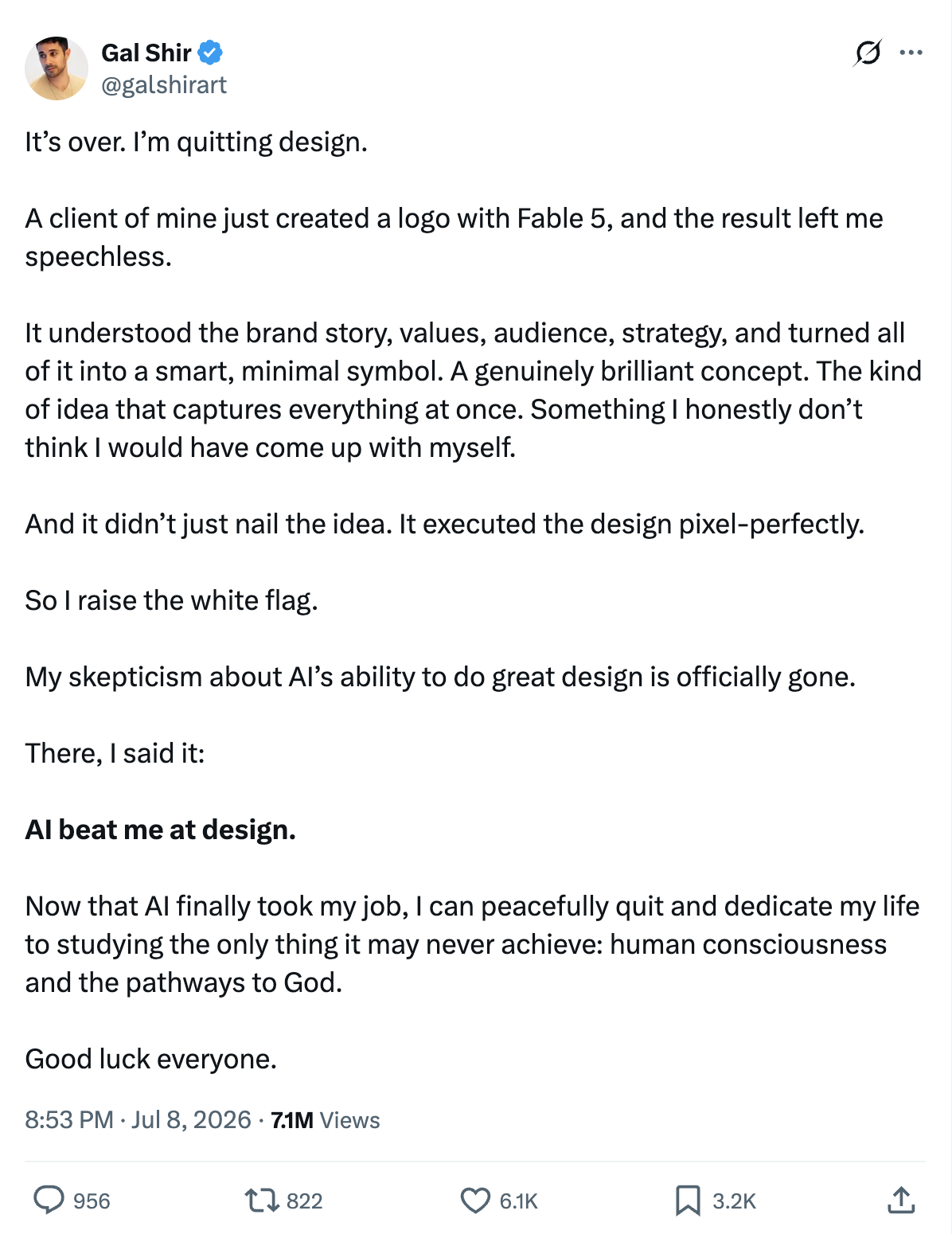
I am sure at some point some creative workers think about this.
My kid has been following Gal Shir (on YouTube) since she was little, and he was the one inspiring her to draw, albeit on the iPad. It’s just amazing how human craft can inspire others, not so much how an AI-drafted illustration does.
My own taxing moments
I think what’s taxing for me is the continual burden to deliver, less time to think. Most companies want to chase up on the profits they lost over the years chasing growth. Almost every company now think they “move fast” and that everybody should track towards it. Long gone the days when deliberate thinking over things were the main feature of a team: discovery-heavy, research-heavy. Now everybody just wants to execute. The chiefs claim they are “hands-on”.
This speed-at-all-cost mentality is further putting is into the trenches. It is good in the surface but not so good in the long-term outlook. The advent of AI further aggravates it, as companies and leadership see it as a non-excusable part of work. “Use AI, or get left behind. There’s no reason not to.”
What’s next?
I don’t know. I think I am leaning towards the idea that work needs to suit the lifestyle we want. The modern tech ethos has fundamentally shifted away from climbing the corporate ladder toward intentionally designing work that serves the lifestyle you want, a perspective championed by industry voices like Lenny Rachitsky, Gergely Orosz, and Justin Welsh, who advocate for autonomy and strict work-life boundaries over corporate prestige. I think I am treating work as a reliable tool to support my life rather than the primary engine of my identity, hopefully allowing me to define my next chapter entirely on my own terms.
Like this?
Consider subscribing, you will get at least a weekly update on things related to alternative views on UX. This blog is an attempt of me to refute, challenge or refresh what I’ve learned and observed about UX design as a career and industry, throughout my 10+ years career as a product designer. Read more about me, or visit my UX portfolio site.